Iqama in Saudi Arabia (إقامة): A Guide for Foreign Workers
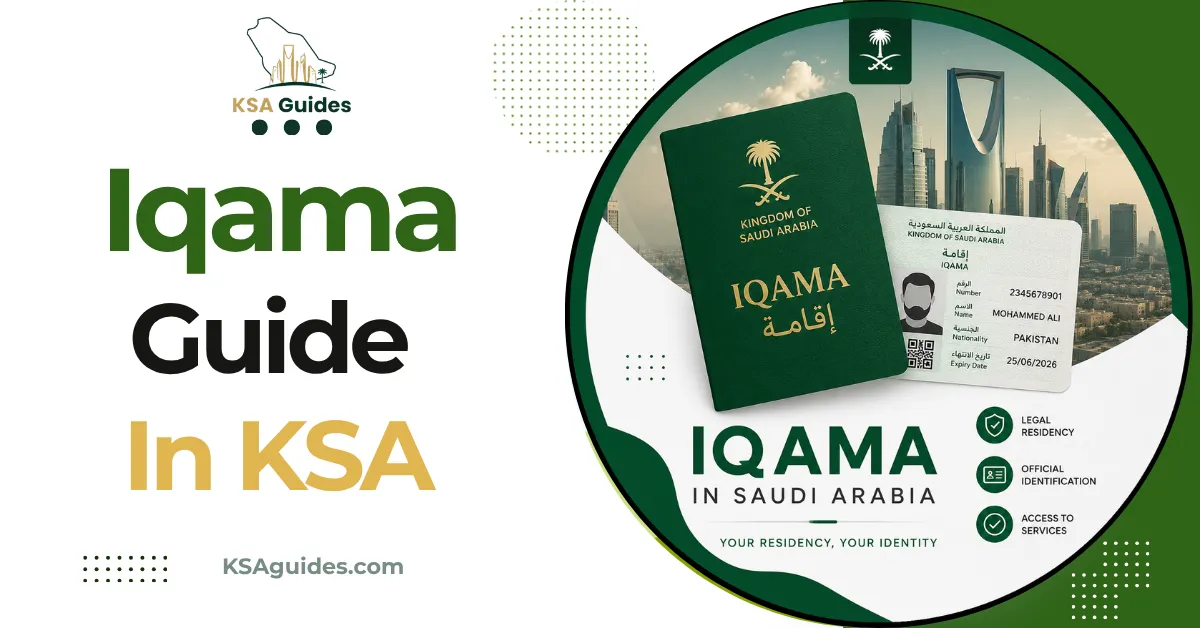
The Iqama (إقامة) is Saudi Arabia’s official residence permit for non-Saudi nationals. The Ministry of Interior issues it through the General Directorate of Passports, known as Jawazat. It is tied to a Saudi sponsor, and serves as your main identity document for banking, healthcare, and travel.
Do This Next:
- Check your Iqama expiry date in Absher today
- Confirm your stated profession matches your actual job
- Check no Iqama fees are deducted from your salary
What an Iqama Actually Is?
Iqama (إقامة) means “residence” in Arabic. In Saudi Arabia it is the official residence permit for every non-Saudi national living in the Kingdom.
It is not a visa. Your work visa only allows you to enter Saudi Arabia once, and it expires shortly after arrival. The Iqama is what makes your stay legal after that. Without a valid one, you cannot legally work, open a bank account, or leave and return. The employer-driven process that produces that entry visa in the first place is covered in the Saudi work visa guide.
The card does four jobs at once:
- Identity. Your primary ID for banking, mobile contracts, rentals, schools, and clinics.
- Work authorisation. It names the exact profession you are permitted to work in.
- Travel basis. Every exit from the Kingdom starts from a valid Iqama.
- Family sponsorship. It lets qualifying workers sponsor a spouse and children.
One quick disambiguation. The same Arabic word also names the second call to prayer recited before salah. The two meanings are unrelated, and this guide covers the residence permit only.
Who Issues Your Iqama?
Three government bodies sit behind the card, and knowing which one does what saves real time.
The Ministry of Interior (MOI) issues the Iqama through the General Directorate of Passports, commonly called Jawazat (الجوازات). Jawazat owns the card itself, its validity, and your exit permissions.
The Ministry of Human Resources and Social Development (MHRSD) owns the work permit that sits alongside it. Your profession, your labour contract, and the levy all live here. Changing the profession printed on your Iqama runs through MHRSD too, as set out in the Iqama profession change guide.
Absher and Muqeem are the digital portals where both sides are actually processed. Absher is your personal account; Muqeem is largely used by your employer.
How to Get Your First Iqama?
Your employer drives most of this. You supply documents and attend appointments.
- Your employer secures a work visa quota through MHRSD
- You collect your entry visa at a Saudi mission abroad
- You enter Saudi Arabia, starting a 90 day issuance window
- You complete a medical examination at an approved centre
- You give fingerprints and a photograph for biometrics
- Jawazat issues the Iqama and your Muqeem record activates
The 90 day window matters more than most new arrivals realise. Miss it and you fall out of status, with penalties landing on your sponsor.
Most workers have the card in hand roughly six to fourteen weeks after accepting the offer. Documentation quality is usually what decides the speed. For many nationalities the chain starts earlier still, with the medical clearance covered in the GAMCA medical status check guide.
Iqama Fees in 2026 and Who Legally Pays Them
Most fee guides list amounts without saying who is legally responsible. That distinction is the single most useful thing on this page.
| Fee | Amount (SAR) | Who Legally Pays | Notes |
|---|---|---|---|
| Iqama issuance or renewal | 650 per year | Employer | Paid to Jawazat |
| Work permit levy (Maktab Amal) | 700 or 800 per month | Employer | Rate depends on your employer’s Saudi to expat ratio |
| Work permit licence | 100 per year | Employer | Routinely omitted from other fee guides |
| Dependent levy | 400 per month, each | Employee | Cleared by the worker through SADAD |
| Health insurance | Varies by cover | Employer | Required under the Council of Health Insurance |
| Absher Business transaction | 51.75 per action | Employer | Value-added platform fee |
| Medical examination | 300 to 500 | Employer | At an approved centre on arrival |
Source: MHRSD published fee schedule; Absher Business | Verified: August 2026
Two corrections worth making, because both circulate widely.
The levy is tiered, not flat. Many guides quote SAR 9,600 a year as if it were fixed.
The published schedule sets SAR 700 per month where expatriate staff do not exceed Saudi staff. Where they do, it rises to SAR 800.
Its name is Maktab Amal, not Musaned. Musaned is the domestic worker recruitment platform, a completely separate system. Searching the wrong name sends you to the wrong portal.
The levy can also be paid quarterly rather than annually. Saudi authorities enabled three, six, nine, and twelve month cycles, with domestic workers excluded from the quarterly option.
The Fee Rule Every Worker Should Know
This is where the money questions get serious, so here it is plainly.
Saudi Labor Law prohibits your employer from deducting work permit fees from your salary. The Iqama fee, the levy, the licence, and your health insurance are all employer costs. The dependent levy is the exception, and the dependent fee guide covers its rate, grace period, and how it is paid. That SAR 400 per month per family member is the worker’s own cost unless your contract says otherwise.
If Iqama fees are being taken out of your pay, that is a labour violation. MHRSD runs a complaints platform called Madad at madad.com.sa for exactly this situation.
Pro Tip: Before booking any trip out of the Kingdom, check your passport validity. Jawazat requires at least 90 days remaining for an exit and re-entry visa, and 60 days for a final exit.
Kafala and What the Labor Reform Initiative Changed
The Iqama operates under Kafala (كفالة), the sponsorship system binding your residence to a Saudi sponsor, or kafeel (كفيل). In almost every case that sponsor is your employer. What the 2025 reforms did and did not change is covered in the Kafala system guide.
Kafala has not been abolished. It has, however, been substantially loosened.
The Labor Reform Initiative took effect on 14 March 2021 and changed three things.
Qualifying workers can now transfer employers after one year without sponsor consent. They can request exit and re-entry visas through Absher directly. They can also process a final exit at contract end without sponsor sign-off.
One important limit applies. The Labor Reform Initiative does not cover domestic workers, who remain under the older rules.
Checking Your Iqama Status
You have three official channels, and each suits a different situation.
Absher is your personal account and the fastest route for expiry dates and travel permissions. Muqeem handles checks by passport or border number, which helps when Absher access is unavailable. Tawakkalna shows status alongside traffic violations in one mobile view, as covered in the Tawakkalna app guide.
Checking expiry regularly is worth the habit. A lapsed Iqama quietly blocks banking and mobile services before you notice anything else.
For the full step by step on each portal, see the Iqama expiry check guide. Absconding status is covered separately in the Huroob check guide.
Renewal, Expiry, and Penalties
Renewal is your sponsor’s legal duty, but the consequences reach you first.
Late renewal carries a sliding penalty. Sources consistently report SAR 500 for a first lapse and SAR 1,000 for a second. A third can expose the worker to deportation.
Renewal also depends on conditions beyond the fee itself. Valid health insurance must be in place, and outstanding traffic fines must be cleared first. The full process and its preconditions sit in the Iqama renewal guide, and checking what you owe is covered in the Iqama fine check guide.
Set a personal reminder 30 days before your expiry date. Relying on your employer’s calendar alone is the most common reason workers end up out of status.
Premium Residency: The Iqama Without a Sponsor
Saudi Arabia launched Premium Residency in 2019 as a sponsor free alternative. Holders live and work without a kafeel, change jobs freely, and sponsor their own families.
Two published routes exist. The permanent option is a one time SAR 800,000, and the renewable option runs SAR 100,000 per year.
Applicants must be at least 21, medically fit, financially capable, and free of a criminal record. It remains a narrow route rather than a realistic option for most workers.
Frequently Asked Questions
What does Iqama mean in Arabic?
Iqama (إقامة) literally means “residence” or “stay” in Arabic. In Saudi Arabia it is the official name for the residence permit issued to non-Saudi nationals.
Can my employer deduct Iqama fees from my salary?
No. Saudi Labor Law makes the Iqama fee, levy, and health insurance the employer’s cost. Deducting them from your pay is a violation.
How long is an Iqama valid?
Standard Iqamas are issued for one or two years and renewed before expiry. Employers can now also renew in three, six, or nine month cycles.
What happens if my Iqama expires?
Penalties are reported at SAR 500 for a first lapse and SAR 1,000 for a second. Banking and mobile services are typically blocked while the Iqama sits expired.
Can I change employers without my sponsor’s permission?
The Labor Reform Initiative allows qualifying workers to transfer after one year of service without sponsor consent. Domestic workers are excluded from this route.
Final Thoughts
The Iqama rules that change most often are the fees, not the framework. Kafala, Jawazat, and the 90 day window have been stable for years. Levy tiers and platform charges get revised without much notice.
The habit worth building is a monthly Absher check. Two minutes confirms your expiry date, profession, and travel permissions. That beats discovering a problem at the airport.
Last verified: August 2026
Reviewed by: Roman Shah
Source: Ministry of Human Resources and Social Development published fee schedule; General Directorate of Passports (Jawazat); Absher Business
Note: Iqama fees, penalties, and eligibility rules are subject to change. Verify current figures with MHRSD or through your Absher account before making any payment or travel decision. Eligibility depends on individual circumstances, so consult MHRSD or a licensed Saudi legal advisor for guidance specific to your case.