The Kafala System in Saudi Arabia: What Actually Changed
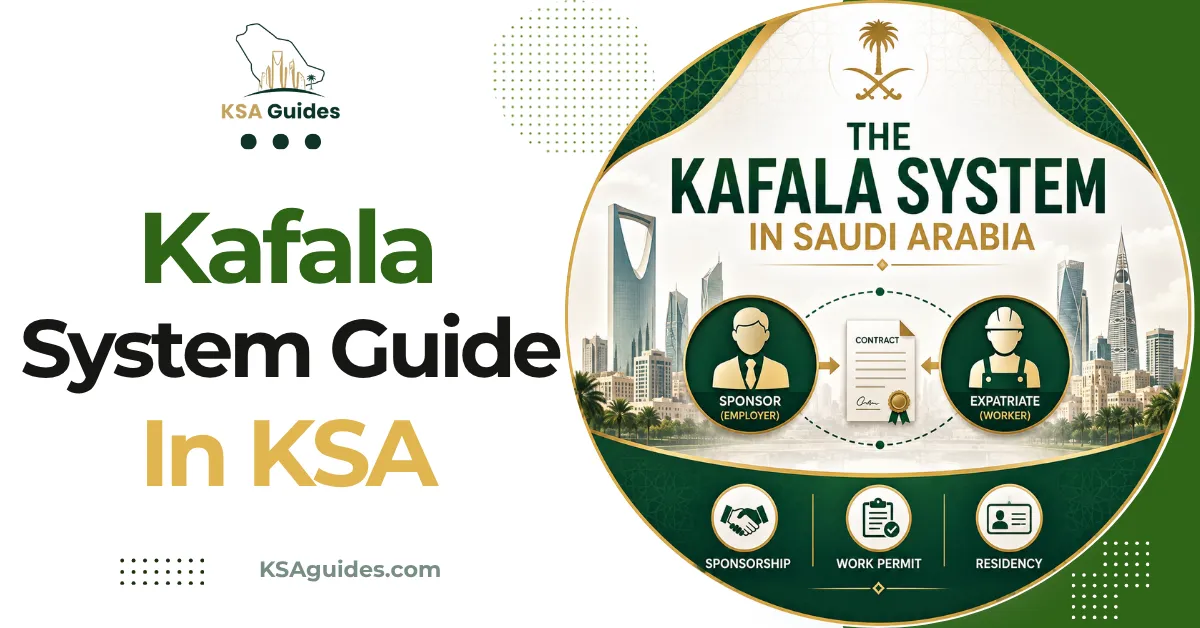
Kafala (كفالة) is Saudi Arabia’s sponsorship framework tying a foreign worker’s residency to a Saudi employer, the kafeel. In 2025, Saudi Arabia announced a shift to contract-based mobility, ending most consent requirements for job changes and exit. The underlying sponsor registration structure remains, and domestic workers are excluded.
Do This Next:
- Confirm your contract status, not just your job title, decides your mobility rights
- Check whether you fall under the general system or the domestic worker system
- Treat “kafala is abolished” headlines as a starting point, not the full picture
What Kafala Actually Is?
Kafala (كفالة) means “sponsorship” in Arabic. Since the 1950s, it has tied a foreign worker’s legal residency to a Saudi sponsor, the kafeel (كفيل).
In practice, that sponsor is almost always the employer. The kafeel’s approval historically governed job changes and leaving the country. In some cases it even governed who held the passport.
That structure produced the well-documented abuses rights groups have raised for decades. Passport confiscation, wage withholding, and blocked exits were the recurring complaints, particularly for domestic workers.
What Was Announced in 2025?
This is the development most guides on this topic have not caught up with yet.
Saudi Arabia announced a shift away from Kafala in June 2025, with implementation reported from October 2025. Government communications describe it as a move from an employer-consent model to a contract-based employment model.
The core concrete changes reported are these. Workers can change employers after their contract ends, or during it with proper notice, without needing employer consent. Exit no longer requires sponsor approval in the qualifying cases. The notice periods and contract rules those changes rest on are covered in the Saudi labor law basics guide.
Passport retention by employers is explicitly prohibited. These are real, specific, checkable changes, not vague promises.
Why “Abolished” Needs a Caveat?
Here is where care matters, because the headline word and the operational reality are not quite the same thing.
Legal practitioners advising on Saudi labour compliance flag this directly. Media headlines widely use the word “abolished.” The actual scope and carve-outs sit in MHRSD and Gazette publications instead.
Several things support treating this distinction seriously.
- Domestic workers are excluded. Reporting indicates roughly 4 million domestic workers remain outside the reformed framework, still governed by the separate Musaned system.
- The sponsor registration structure has not disappeared. An employer is still the legal entity a worker’s Iqama is registered against. It still bears the fees under Article 40 and still initiates most actions through Qiwa and Absher.
- Exit still runs through a government process, not a free pass. Removing the consent requirement is not the same as removing the exit process itself. A request through MHRSD or Absher is still typically required.
- The word kafeel is still in active, current use. Government and legal sources throughout 2026 still use “kafeel” and “sponsor” routinely. Iqama renewal, transfer, and exit procedures are described in exactly those terms.
None of this means the 2025 reform is meaningless. It means the accurate description is a loosening of consent requirements within a structure that still exists. The structure itself has not disappeared.
What This Means for Your Daily Situation?
Translating the policy language into practical terms matters more than the label.
With an ended contract, or proper notice given during it, your employer’s sign-off should not be needed to move jobs. That is the headline change, and it is real.
Your Iqama is still tied to an employer of record. Fees, renewal responsibility, and Nitaqat compliance all still run through that employer under Article 40. Full detail sits in the Iqama guide for foreign workers.
If your employer refuses to cooperate despite the reform, the escalation path has not changed. MHRSD’s complaint process remains the route, covered in the renewal without kafeel guide.
A huroob report filed against you sits alongside a separate 2025 reform, the Qiwa integration for absence reports specifically. That process is covered in full in the huroob check guide.
Rights Groups Have Flagged Real Concerns
Presenting only the government framing would be incomplete, so the other side of this deserves space too.
Labour and anti-slavery organisations have publicly questioned whether the reforms go far enough. Some have also noted the timing coincides with Saudi Arabia’s preparations to host the 2034 FIFA World Cup. That is a documented concern, not a settled conclusion either way.
A near-identical pattern followed the Kingdom’s 2021 reforms. Officials described those changes as ending restrictive practices at the time.
Rights groups separately noted that exit still required a government-mediated process. Absence reports also remained a tool some employers used against workers.
Whether the 2025 reforms close those specific gaps is something independent monitoring will need time to establish. Reasonable people currently hold different views on how complete this reform actually is in practice.
What Domestic Workers Should Know?
This carve-out deserves its own clear statement, since it affects millions of people directly.
Domestic workers remain under Musaned, a separate platform with separate rules, rather than the reformed contract-based framework described above. Status checks for this group run through Absher rather than the general MHRSD inquiry.
Anyone working in a domestic role should not assume the general reforms in this guide apply to them. Confirm your own status directly.
Frequently Asked Questions
Has Saudi Arabia actually abolished the Kafala system?
The government announced a shift to a contract-based model in 2025, ending most consent requirements for job changes and exit. The underlying sponsor registration structure and employer fee obligations remain in place.
Do domestic workers benefit from the 2025 Kafala reforms?
No, domestic workers remain under the separate Musaned system rather than the reformed general framework. This exclusion is explicitly reported alongside the wider changes.
Can I still be blocked from changing jobs under the new system?
Employer consent is generally no longer required after your contract ends or with proper notice during it. Specific contract terms and timing still affect exactly when that right applies.
Does the reform mean I no longer need a sponsor at all?
No, your Iqama remains registered against an employer of record who still bears renewal fees under Article 40. What changed is consent for mobility, not the registration structure.
Final Thoughts
The most useful way to hold this topic is as a loosening within a structure. It is not the structure’s end. That framing matches both what the government has concretely changed and what continues to operate exactly as it did before.
Whichever term you use for it, the practical questions that matter are the same ones this cluster covers throughout. Who bears which fee, what triggers a transfer without consent, and where to escalate when a process stalls.
Last verified: August 2026
Reviewed by: Roman Shah
Source: Saudi Press Agency; MHRSD; Saudi Labor Law Article 40; legal practitioner guidance on 2025 labour reform implementation
Note: this is a rapidly evolving area of law. Scope, carve-outs, and implementing details continue to be published by MHRSD and the Official Gazette. Consult MHRSD or a licensed Saudi labour advisor for guidance specific to your contract and situation. This guide is general information and not legal advice.