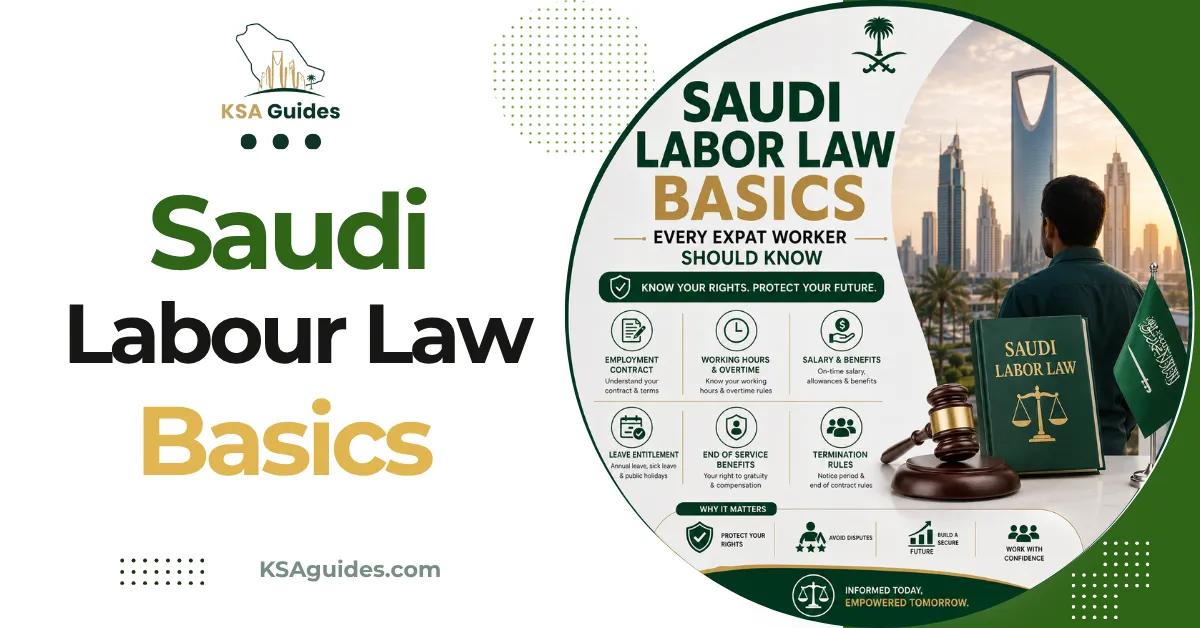
Saudi Labor Law Basics Every Expat Worker Should Know
Saudi Labor Law sets standard hours at 8 per day or 48 per week, with overtime at 150 percent pay. Probation runs 90 days by default, extendable to 180 with written agreement. Annual leave starts at 21 days, rising to 30 after five years with one employer.
Do This Next:
- Check your contract states your working hours and leave terms clearly
- Confirm whether your probation period was extended in writing
- Know your notice period before you need it
Working Hours and Overtime
Article 98 sets the standard at 8 hours a day or 48 hours a week. These are hard limits, not targets an employer can casually exceed.
During Ramadan, Muslim employees work reduced hours: 6 hours a day, or 36 a week. No worker can be required to work more than 5 consecutive hours without a 30 minute break. Anything beyond standard hours counts as overtime under Article 107. The rate is 150 percent of your normal hourly wage, meaning your hourly rate plus an extra 50 percent.
To find your hourly rate, divide your basic monthly salary by 240. A SAR 9,600 monthly salary gives an hourly rate of SAR 40, so overtime pays SAR 60 per hour. Annual overtime is capped at 720 hours. Exceeding that cap needs your explicit written consent, not just a verbal request from your employer.
A 2025 change lets overtime be compensated with paid leave instead of cash. The rate is 1.5 hours of leave per overtime hour. This route requires your written consent and cannot simply be imposed.
Probation Period
Article 53 sets probation at up to 90 days by default. That is the starting point, not a fixed rule that never changes.
With written agreement from both sides, it can extend to a combined maximum of 180 days. Some guides describe 180 days as the new standard. That figure is really the maximum extended length, not the automatic default.
Either party can end the contract during probation without notice or compensation, unless the contract states otherwise. Read your specific contract terms rather than assuming the general rule applies unmodified.
Annual Leave
Paid annual leave starts at 21 days after your first year of service, under Article 109.
That rises to 30 days once you complete five continuous years with the same employer. Public holidays and the weekly rest day do not count against this balance.
Your employer must notify you of approved leave dates at least 30 days in advance. Apply for leave in writing or through your HR system, since documentation matters if a dispute arises later.
Weekly Rest and Public Holidays
Friday is the standard paid weekly rest day, and it must be at least 24 consecutive hours.
An employer can substitute a different day for specific workers, but only after notifying the local labour office. Public holidays are separate from your annual leave balance entirely.
Nationally recognised paid holidays include Saudi Founding Day, Eid Al-Fitr, Arafat Day, Eid Al-Adha, and Saudi National Day. Work performed on any of these counts fully as overtime.
Resignation, Termination, and Notice
Indefinite contracts generally require notice before ending. Reporting indicates 30 days from the employee and 60 days from the employer, following 2025 reforms.
Article 81 lists specific reasons an employee can resign without notice or penalty. These include an employer assigning work without consent, failing statutory obligations, or mistreatment.
Article 80 covers the employer’s side, listing specific grounds for termination without the usual end of service payment. Serious misconduct and fundamental contract breaches are the typical grounds covered.
Full detail on how termination and resignation affect your final payout sits in the end of service benefits guide.
Sick Leave
Workers are entitled to 120 days of sick leave per year, structured in stages rather than paid uniformly throughout.
Full pay applies for an initial period, followed by reduced pay for a later stretch. A doctor’s certificate is required to claim it, so keep documentation from the start.
Pro Tip: Request sick leave and annual leave in writing every time, even in an informal workplace. A written record protects you if a dispute comes up months later.
Contracts for Non-Saudi Employees
One 2025 change specifically affects expat workers without a fixed contract term.
Reporting indicates contracts with no set term now default to one year, renewing automatically as long as work continues. Confirm which contract type you actually hold, since this affects your notice obligations directly. Contract-based mobility replaced most employer-consent requirements in 2025, as covered in the Kafala system guide.
If Something Is Not Being Followed
MHRSD oversees labour law compliance, and workers can raise disputes through its channels, including the Qiwa dispute system.
Companies violating labour law can face consequences beyond a single employee dispute, including restrictions on work permit issuance. Documentation of the issue is your strongest position, the same principle covered throughout this cluster for sponsorship and payment disputes.
Frequently Asked Questions
What are standard working hours under Saudi Labor Law?
Eight hours a day or 48 hours a week under Article 98. Ramadan cuts that to six hours daily for Muslim staff.
How much is overtime pay in Saudi Arabia?
150 percent of your normal hourly rate under Article 107. Divide your basic monthly salary by 240 to find your hourly rate before calculating overtime.
How long is the probation period in Saudi Arabia?
Up to 90 days by default, extendable to a combined maximum of 180 days with written agreement from both parties. Either side can end the contract during probation without notice.
How much annual leave am I entitled to?
21 days after one year of service, rising to 30 days after five continuous years with the same employer. Public holidays and weekly rest days do not count against this balance.
Final Thoughts
Most labour disputes in Saudi Arabia trace back to unfamiliarity with these basics rather than deliberate violation on either side. Knowing the actual article and figure turns a vague complaint into a specific, checkable claim.
Keep a personal note of your contract type, probation length, and notice period. These three details answer most of the questions that come up unexpectedly during employment.
Last verified: August 2026
Reviewed by: Roman Shah
Source: Saudi Labor Law, Articles 53, 80, 81, 98, 107, and 109; MHRSD
Note: labour law figures and reforms are updated periodically. This guide is general information and not legal advice. Consult MHRSD or a licensed Saudi labour advisor for guidance specific to your contract.