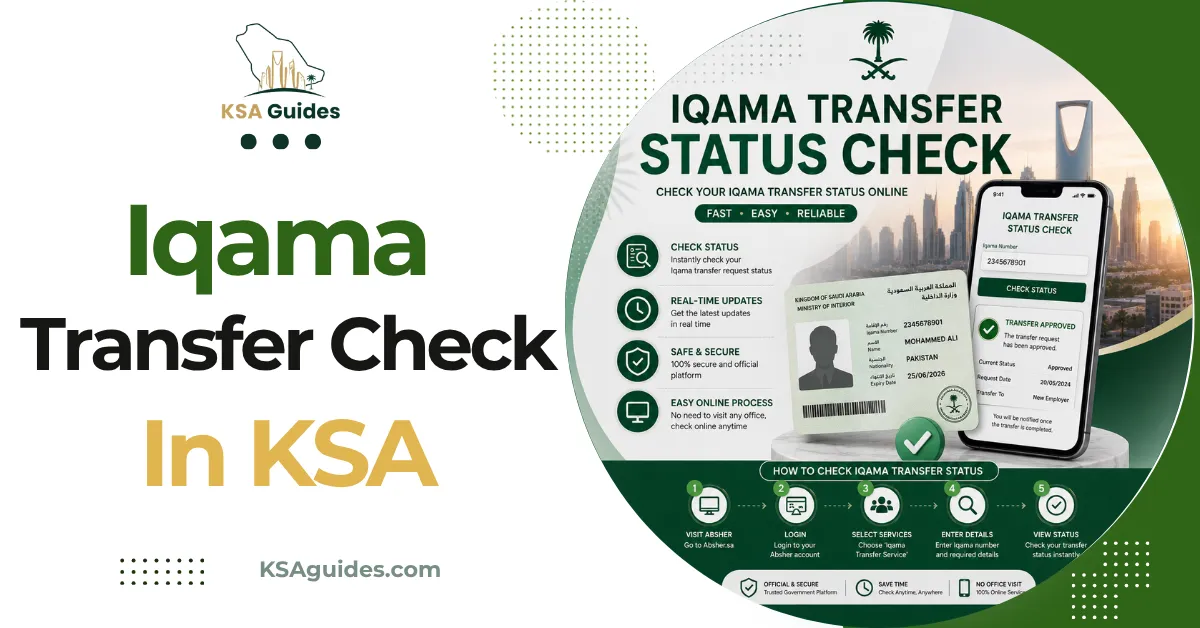
Iqama Transfer Status Check KSA: Process and Fees
Check your Iqama transfer status by logging into your Qiwa Individual account, where the request stage shows in real time. The process, called Naqal Kafala or a Service Transfer, moves through Qiwa and Absher together. Fees are tiered by transfer count and legally paid by the new employer.
Do This Next:
- Log in to Qiwa Individual to see your transfer stage
- Respond to any pending offer within 10 days
- Confirm the new employer is paying the transfer fee, not you
How to Check Your Iqama Transfer Status?
The process is fully digital now, which makes checking it far simpler than it once was.
- Log in to your Qiwa account under Individuals
- Open the Service Transfer or contract section
- Read the current stage of your request
The same request also appears in Absher Individuals, where you formally accept or reject an offer. Checking either platform shows a consistent status, since they share the same underlying record.
The Iqama Transfer Process Step by Step
Six stages take a transfer from offer to a fully updated Iqama record.
- A new employer creates a digital job offer in Qiwa’s contract module
- You review and e-sign the offer, generally within 10 days
- The new employer submits a Service Transfer request
- You accept the transfer in Absher, again within a set window
- MHRSD calculates your notice period from the current contract
- Jawazat updates your Iqama record under the new sponsor
Missing the response window is the most common reason a transfer stalls. Set a reminder the moment an offer appears rather than waiting to review it later.
The Real Fee Schedule
This is where a lot of guides quote a single flat number that no longer matches reality.
| Transfer Count | Fee (SAR) | Who Pays |
|---|---|---|
| First transfer | 2,000 | New employer |
| Second transfer | 4,000 | New employer |
| Third or later | 6,000 | New employer |
Source: MHRSD transfer fee schedule | Verified: August 2026
The fee rises each time you transfer, not with how long you have worked. A worker on their third transfer pays the highest tier regardless of tenure at any single employer.
This fee is legally the new employer’s cost, not yours. A prospective employer deducting it from your salary or offer letter is a labour violation. Report it to MHRSD.
When You Can Transfer Iqama Without Consent?
Five grounds currently allow a transfer without your current employer’s approval, more than most guides list.
- Your employment contract has expired or been terminated
- You have completed more than one year of service without breaching your contract
- Your employer has not paid wages for three consecutive months
- Your employer failed to renew your Iqama or work permit after it lapsed
- Your establishment sits on Red Nitaqat status, has closed, or is otherwise non-compliant
Meeting one of these grounds does not guarantee an automatic transfer. It removes the requirement for your current sponsor’s sign-off specifically.
Full detail on what a red Nitaqat band means for your options sits in the Iqama red green status guide.
What Blocks a Transfer?
A handful of conditions stop a transfer regardless of which grounds apply.
An active huroob report blocks any transfer request. Resolve that first, using the process in the huroob check guide.
The new employer must be compliant too. They need active MHRSD registration, an acceptable Nitaqat standing, and compliance with the Wage Protection System.
Domestic workers follow a different system entirely. Transfers for this category run through Musaned rather than Qiwa, with separate rules.
What Happens to Your Family’s Iqamas?
Dependents generally follow the primary sponsor’s transfer, but the timing is not always instant.
Expect a short administrative lag between your own transfer completing and your dependents’ records updating to match. Confirm this directly with your new employer’s HR team rather than assuming it happens automatically the same day.
Pro Tip: Screenshot your Qiwa status page at each stage of the process. A dated record of exactly where a transfer stalled speeds up any MHRSD escalation. Memory alone is a weaker case.
Frequently Asked Questions
How do I check my Iqama transfer status?
Log in to your Qiwa Individual account and open the Service Transfer section to see the current stage. Absher shows the same status once you have a pending offer to accept.
How much does an Iqama transfer cost?
The fee is tiered by transfer count: SAR 2,000 first, SAR 4,000 second, SAR 6,000 for a third or later. The new employer pays this by law, not the worker.
Can I transfer without my current employer’s consent?
Yes, under five specific grounds, including an expired contract, over a year of service, or unpaid wages. Meeting a ground removes the consent requirement, not other conditions like an active huroob report.
Does a huroob report block a transfer?
Yes, an active absence report blocks any transfer request until it is resolved. Check and address it first using the official inquiry service.
Final Thoughts
The tiered fee structure is worth remembering specifically. Many older guides still quote a single flat figure that no longer applies. Whether a transfer costs 2,000 or 6,000 riyals depends entirely on how many times you have moved before. Changing the profession on your Iqama is a separate process with its own fee, covered in the Iqama profession change guide.
Whichever situation applies to you, the new employer’s compliance matters as much as your own eligibility. A qualifying worker can still get stuck if the receiving establishment is not in good standing itself.
Last verified: August 2026
Reviewed by: Roman Shah
Source: Qiwa Service Transfer platform; MHRSD transfer fee schedule; Absher Individuals
Note: transfer fees, eligibility grounds, and processing timelines are subject to change. Confirm current requirements directly through Qiwa or MHRSD before initiating or accepting a transfer.