Iqama Red Green Status: What the Colour Actually Means?
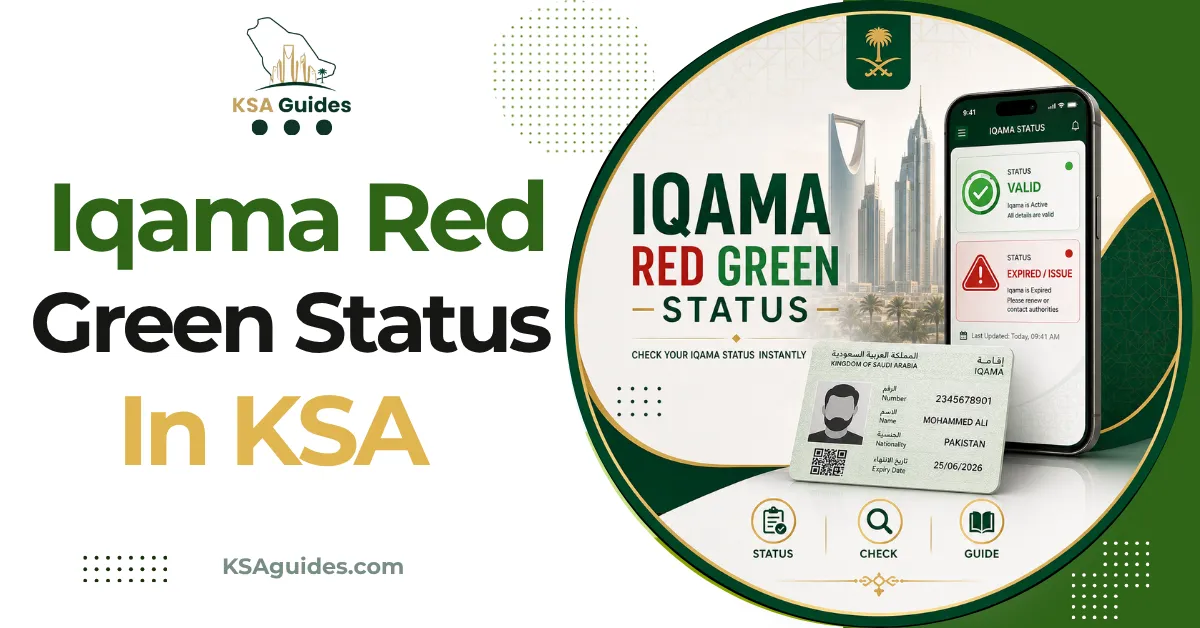
Iqama red green refers to your employer’s Nitaqat band, not your Iqama itself. Check it free on the MHRSD non-Saudi employee inquiry using your Iqama number. A red band lets you transfer to a new employer without your sponsor’s consent.
Do This Next:
- Run the MHRSD inquiry with your Iqama number
- Read the colour shown beside your employer name
- If red, a transfer needs no sponsor consent
Your Iqama Does Not Have a Colour
Start here, because the search term itself is misleading.
No colour is printed on your Iqama, stored against it, or attached to you personally. The colour belongs to your employer.
It comes from Nitaqat (نطاقات), the Saudization programme run by the Ministry of Human Resources and Social Development. Nitaqat grades private establishments on how many Saudi nationals they employ.
So “iqama red green” really asks one question. How compliant is the company that sponsors me, and what does that mean for my options?
How to Check Your Employer’s Nitaqat Colour?
The MHRSD non-Saudi employee inquiry returns it free, with no Absher login.
- Open the non-Saudi employee inquiry on the MHRSD portal
- Enter your Iqama number, or a border or passport number
- Select your nationality if not using an Iqama number
- Enter the captcha code on screen
- Submit and read the colour beside your employer’s name
The same result page shows several fields at once. Your job status sits there too, which is where an absence report would appear.
That is a separate check with separate consequences. The huroob check guide covers reading that field properly.
The Five Nitaqat Bands
| Band | What It Means | Effect on Expat Staff |
|---|---|---|
| Platinum | Exceeds the sector target | Fastest visas, unrestricted transfers |
| High Green | Comfortably above target | Broad hiring, renewals, profession changes |
| Mid Green | Solidly compliant | Standard processing and incentives |
| Low Green | Meets the minimum only | Reduced hiring flexibility |
| Red | Below the required rate | Renewals blocked, staff free to leave |
Source: Qiwa official Nitaqat classification | Verified: August 2026
One correction matters here, because plenty of guides still get it wrong.
There is no Yellow band. It was retired in December 2021 when the revised Nitaqat framework took over.
Any guide still listing Yellow between Green and Red is describing a system that ended years ago. The current ladder runs Red, Low Green, Mid Green, High Green, Platinum.
What a Red Band Means for You?
This is the part written for workers rather than HR departments.
A red establishment loses access to most labour services. New work permits stop, Iqama renewals are blocked, new visas cannot be issued, and government tenders close off.
That sounds purely like an employer problem. It is not, because a blocked renewal lands on your residency status directly.
The compensating rule is significant. Staff at red establishments can transfer to a new employer without the current sponsor’s consent.
A prospective employer can hire you from a red company without needing prior approval from your existing one. If your renewal has stalled and the colour is red, that is usually the reason and also the route out.
Pro Tip: Check the colour before you accept an offer, not after. A prospective employer in Low Green or Red may struggle to issue your visa at all. The salary is irrelevant if the transfer cannot process.
Why a Company With Saudi Staff Can Still Be Red?
The calculation is weighted, which surprises people who assume it is a simple headcount.
- A Saudi employee earns a full point only at SAR 4,000 per month or above
- Below that wage floor, the credit halves
- An employee with a disability counts as four points, capped at 10 percent of the workforce
- Flexible-work Saudis earn a full point at 160 logged hours a month
Required percentages also vary by sector and company size. Banking sits far higher than construction, so the same headcount produces different bands in different industries.
Nitaqat applies to establishments with six or more workers. Smaller employers sit outside the banded system entirely.
What Changed in 2026?
Two updates matter if you are comparing this against older guidance.
Since 15 April 2026, a Saudi employee only counts toward the rate when their contract is electronically documented on Qiwa. GOSI registration alone is no longer enough, though it still matters on your own record, as covered in the GOSI check guide.
The 2026 cycle also raised most band thresholds. A company that held Mid Green last year can slip to Low Green without losing a single Saudi employee.
Profession-specific quotas now run alongside the overall band. Some administrative roles carry full localisation requirements calculated separately from the establishment’s colour.
When the Result Looks Wrong?
Three explanations cover almost every confusing result.
- No colour displayed. Your establishment may have fewer than six workers, placing it outside Nitaqat.
- Colour changed with no staffing change. Thresholds are revised annually, so the bar moved rather than your company.
- Nothing found at all. Check your Iqama number, and confirm the nationality matches if using a passport number.
For the wider set of MHRSD lookups and which service answers which question, see the MOL iqama check guide.
Frequently Asked Questions
Does my Iqama have a red or green status?
No, the colour belongs to your employer’s Nitaqat band rather than to you. You check it using your Iqama number, which is where the confusion starts.
What happens if my company is in the red band?
Work permit and Iqama renewals are blocked, and new visas cannot be issued. Staff may transfer to a new employer without the current sponsor’s consent.
Is there still a Yellow Nitaqat band?
No, Yellow was retired in December 2021 under the revised Nitaqat framework. The current bands are Red, Low Green, Mid Green, High Green, and Platinum.
How do I check Nitaqat colour without Absher?
Use the MHRSD non-Saudi employee inquiry with your Iqama, border, or passport number. No login is needed and the check is free.
Final Thoughts
The colour is worth checking at two specific moments rather than routinely. Check it when a renewal stalls without explanation, and check it before accepting a new offer.
Band thresholds now move every year. A colour says more about this year’s targets than about how an employer treats staff. Treat it as a signal about paperwork friction, not as a verdict on the employer.
Last verified: August 2026
Reviewed by: Roman Shah
Source: Qiwa official Nitaqat classification; MHRSD non-Saudi employee inquiry
Note: Nitaqat thresholds, band effects, and Saudization percentages are revised annually and vary by sector. Confirm your establishment’s current status through Qiwa or MHRSD before making any employment decision.