Saudi Visa Rejected or Expired: What to Actually Do
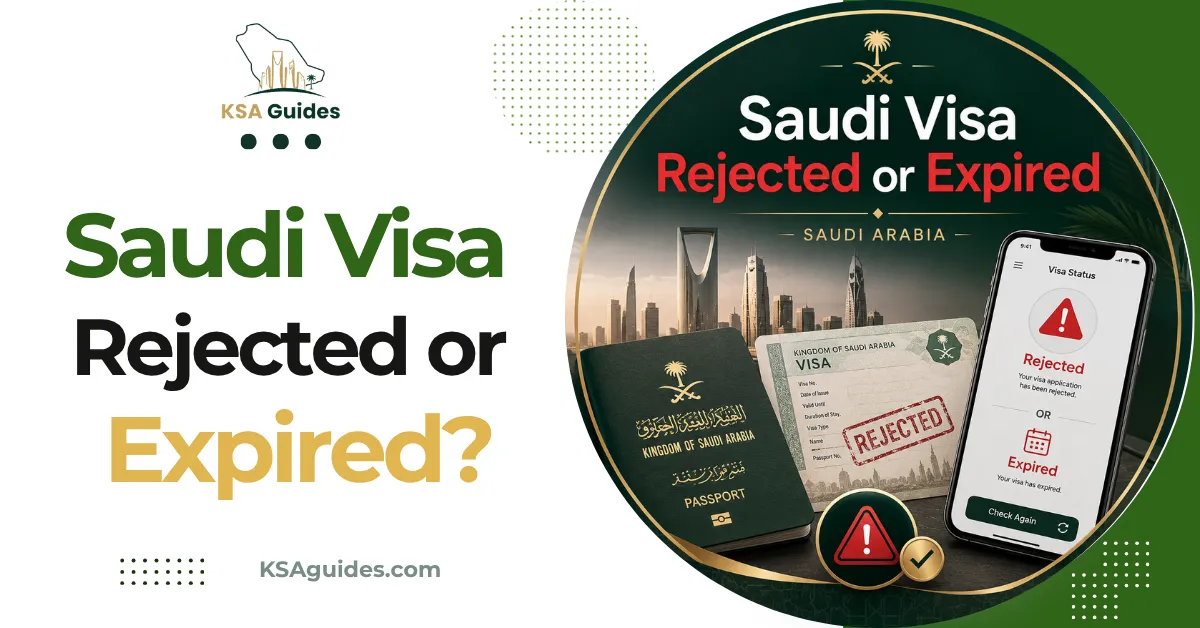
A rejected Saudi visa application can often be corrected and resubmitted, sometimes immediately. An expired or overstayed visa is a different problem entirely. Saudi Arabia runs four separate penalty regimes depending on which document expired, not one universal overstay fine.
Do This Next:
- If rejected, identify whether the cause was clerical or purpose-related
- If overstayed, identify which of four situations actually applies to you
- Report or resolve the issue through Absher rather than waiting
If Your Application Was Rejected
Rejection before travel and an overstay after travel are completely different problems, with different fixes.
Clerical or documentation errors are the easiest to resolve. Correct the specific issue and reapply immediately, without a waiting period.
Purpose of Visit or security-related refusals are more serious. Reporting indicates a wait of at least 90 days is advisable before submitting a new application in these cases.
Common Rejection Reasons
Several causes recur across tourist, business, and Umrah applications alike.
- Previous overstays or deportation history, which flags future applications automatically
- Inconsistent or unclear travel purpose, particularly when it does not match the visa category selected
- Immigration violations in other GCC countries, since data increasingly shares across the Gulf region
- Passport issues, such as under six months of validity or too few blank pages
- Missing supporting documents, including accommodation proof or return travel evidence
A rejection does not permanently close every door. Changing visa category after a rejection is generally possible. A single clerical rejection does not carry the same weight as a repeated pattern.
Pro Tip: Applying for Umrah? Confirm your travel agency’s license on the Ministry of Hajj and Umrah’s website first. A large number of agencies lost their licenses in early 2026 over service quality.
There Is No Single Overstay Fine
This is the single most important correction on this page, and it applies across the whole visa system.
Saudi Arabia runs four separate penalty regimes, not one universal daily fine. Which rules apply depends entirely on which specific document has expired.
| Situation | Where It’s Covered |
|---|---|
| Visit visa overstay | This guide, below |
| Iqama late renewal | Iqama renewal guide |
| Expired exit/re-entry or final exit visa | Exit re-entry visa guide |
| Huroob absconding | Huroob check guide |
Treating these as one interchangeable “overstay fine” is the single most common source of wrong assumptions on this topic.
Visit Visa Overstay: What Is Actually Confirmed
This section deserves particular care, since widely repeated figures are not the same as officially published ones.
Figures of SAR 100 per day, plus tiered penalties of SAR 15,000, 25,000, or 50,000, circulate very widely online. Saudi Arabia has not published a single official tariff matching these exact figures.
What is confirmed in law is a maximum penalty of SAR 50,000. Up to six months in jail, deportation, and a re-entry ban can also apply.
Treat the specific daily and tiered figures as commonly reported estimates, not a confirmed schedule. Confirm your exact situation with Jawazat through Absher.
Sponsors Now Face Their Own Penalty
This enforcement wave is recent enough that many guides have not caught up with it yet.
In February 2026, Saudi authorities significantly increased sponsor accountability for visit visa overstays. A sponsor who fails to report an overstaying visitor can face a SAR 50,000 fine and imprisonment. Non-Saudi sponsors also risk deportation.
Reporting an overstay runs through Absher or the 992 hotline. Doing so is mandatory once a sponsor becomes aware of the situation. Nearly 20,000 enforcement actions were recorded in a single month during this initial push.
A Constructive Option: The Self-Deportation Platform
For anyone already in an irregular status situation, this route is worth knowing about.
Saudi Arabia introduced a digital Self-Deportation Platform in 2026. It allows individuals with expired visas, expired Iqamas, or unauthorised overstays to complete exit formalities digitally and leave voluntarily.
This route avoids the traditional detention-to-removal pathway. Voluntary, documented exit is consistently treated more favourably than being found and processed through enforcement.
Re-Entry Bans Vary by Situation
Not every overstay produces the same ban length, and one specific rule changed for the better.
The rule banning re-entry for failing to return before an exit/re-entry visa expired was lifted in mid-2025. A huroob-related ban, by contrast, still runs three to five years in serious cases.
Confirm which specific rule applies to your situation before assuming the harshest possible outcome. These rules have genuinely diverged from each other.
Frequently Asked Questions
Can I reapply immediately after a rejected Saudi visa?
Yes, if the rejection was due to a clerical or documentation error. Purpose-related or security-related refusals warrant waiting at least 90 days before reapplying.
Is there one standard fine for overstaying a Saudi visa?
No, Saudi Arabia runs four separate penalty regimes depending on which document expired. Visit visa overstay, Iqama renewal, exit visa expiry, and huroob each follow different rules.
Is the SAR 15,000 to 50,000 overstay fine official?
These figures are widely reported but not confirmed as an official published tariff. What is confirmed in law is a maximum penalty of SAR 50,000, jail time, deportation, and a re-entry ban.
What is the Self-Deportation Platform?
A 2026 digital option letting people with expired visas or Iqamas leave Saudi Arabia voluntarily. It avoids the traditional detention-to-removal process for irregular status.
Final Thoughts
The most valuable habit this topic rewards is precision about which situation actually applies to you. A rejected application, a visit visa overstay, a lapsed Iqama, and a huroob report are four different problems. Each needs its own fix.
Where genuine uncertainty exists, including the exact overstay fine figures, treat confident-sounding numbers online with some caution. Confirm directly with Jawazat through Absher.
Last verified: September 2026
Reviewed by: Roman Shah
Source: General Directorate of Passports (Jawazat); Saudi Ministry of Interior; Saudi Press Agency
Note: penalties, rejection rules, and enforcement practices are subject to change and are actively evolving. This guide is general information and not legal advice. Confirm your specific situation with Jawazat, MHRSD, or a licensed Saudi immigration advisor before acting.